Meta Just Switched On a New Way of Counting Conversions — What It Means for Your Ads — Harsh Sahu

Meta has switched on a new way of counting conversions — and if you run ads, your reports are about to change even though you changed nothing.
The feature is called “Measure conversions on customer devices.” Meta’s own Help Centre page, “About measuring conversions on customer devices” — verified 10 November 2026 — says it is turned on by default. The start date does not appear on that help page; Meta’s Events Manager toggle notice puts the switch-on at 12 November 2026, as reported by PPC Land on 27 October 2026.
What it actually does
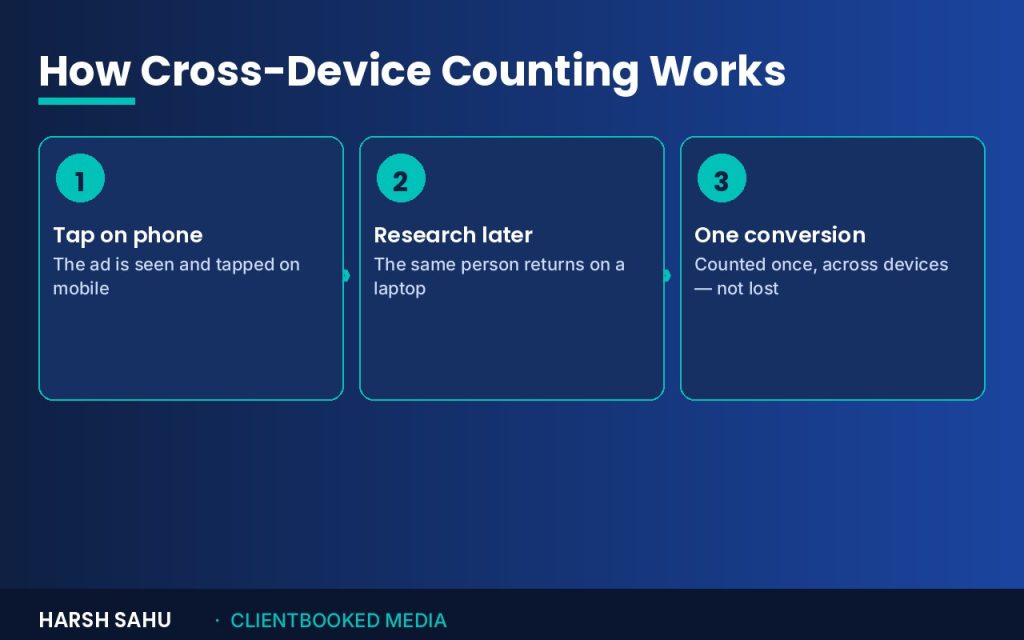
Until now, a conversion was counted when Meta’s systems could connect a purchase back to an ad view. Some purchases never got connected — the trail went cold — and those conversions simply went unmeasured. Your ads may have driven them, but your reports never showed them.
With this feature, the matching happens on the customer’s own device, where both the ad view and the purchase are present. It uses information the customer has already shared with the business — such as an email address — plus temporary, non-identifying device information. Meta says no identifying customer information is shared with Meta itself: Meta only receives confirmation that a purchase happened and which campaign to attribute it to.
Two things it does not do, straight from Meta: it works alongside your existing Pixel and Conversions API setup and does not replace either of them. And your attribution window and attribution model do not change — this affects which conversions can be measured, not how they are credited to your ads.
It is also not active for people located in the EU and UK.
What this means for appointment-based businesses
Be honest about the scope. The help page states no technical requirements — it does not say the Pixel must be installed a particular way, and it does not require a site login. What matters for you is the reporting effect.
From 12 November, you may see your reported conversions rise. Do not mistake that rise for better ad performance. It is a counting change: conversions your ads were already driving, now visible. Your cost per booking may look lower overnight. It is not lower. The same money bought the same bookings — the measuring got better.
That distinction matters twice over. First, do not raise budgets on the strength of a reporting jump that is not a performance jump. Second, do not let anyone sell you a “we improved your results” story in mid-November that is really just Meta’s new counting.
The check to run this week
- In Events Manager, go to Data sources, open your Pixel, then Settings — and confirm whether “Measure conversions on customer devices” is on. It is on by default, and it can be switched off per Pixel if you ever need to compare.
- Note your current cost per booking before 12 November, so you can separate the counting change from any real change after it.
- If your agency reports a sudden improvement in the second half of November, ask one question: “Is this the new Meta measurement, or did something actually change?”
Meta changes how it counts quietly, and the advertisers who get hurt are the ones who assume “nothing changed because I changed nothing.” A two-minute settings check is cheaper than a month of budget decisions made on a number that moved for the wrong reason.
Source: Meta Ads Help Centre, “About measuring conversions on customer devices” — verified 10 November 2026. The 12 November 2026 start date comes from Meta’s Events Manager toggle notice as reported by PPC Land, 27 October 2026. Harsh Sahu is the founder of ClientBooked Media, where he builds psychology-led Facebook and Instagram ad campaigns for appointment-based businesses: https://harshsahu.in/what-i-do/

Harsh Sahu
Performance marketer specialising in psychology-led Meta ads, offers and funnels for booked consultations. More about Harsh Sahu →