The First 3 Seconds: The Psychology That Decides Whether Your Ad Lives or Dies — Harsh Sahu

I’m Harsh Sahu, founder of ClientBooked Media, and I have watched thousands of ads die the same way. Not after a week of bad numbers. Not after a failed test. They die in the first three seconds — before the viewer has read a single word of the offer, before the landing page ever loads, before the funnel gets a chance to work.
Your ad does not get three seconds of attention. It gets three seconds to earn attention. That is a completely different job.
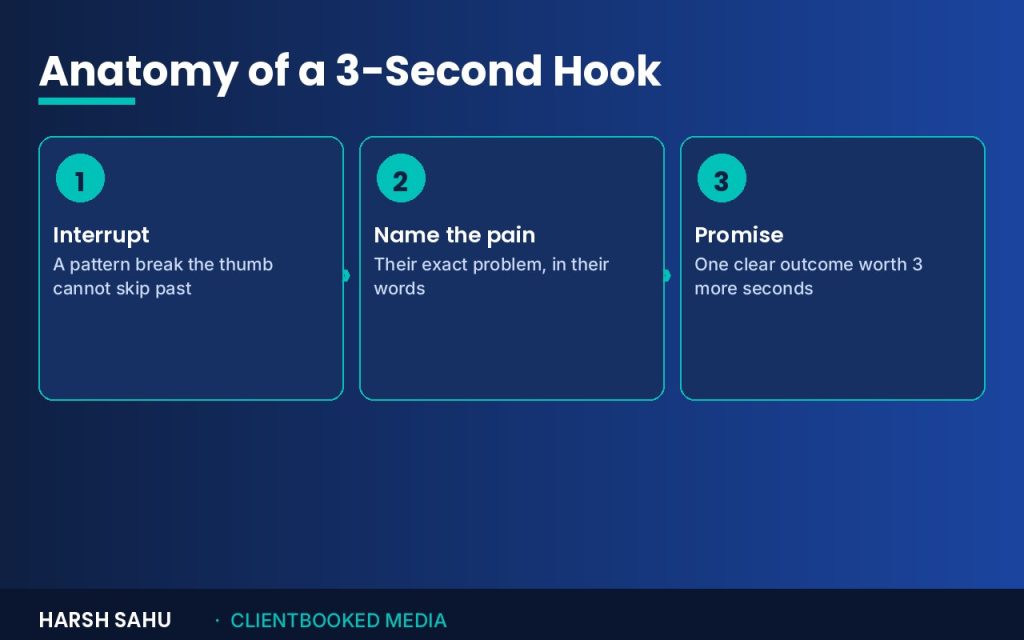
Your customer’s brain is a bouncer, not an audience
Here’s the psychology most advertisers ignore. The human brain processes far more information than it can consciously handle, so it runs a ruthless filter. Anything familiar, predictable or irrelevant gets waved past without a second thought. Only three things get through the door: something new, something that looks like a threat or an opportunity, and something that matches what the person is already thinking about.
Your ad is competing with a baby photo, a friend’s holiday video, a news story and a meme — all in the same scroll. The brain’s question is not “is this ad good?” It is “does this matter to me, right now, in this second?” If the answer is not obvious instantly, the thumb moves on. The scroll is the default. Stopping is the exception you have to cause.
That is why the first three seconds are not the start of your ad. They are the whole audition.
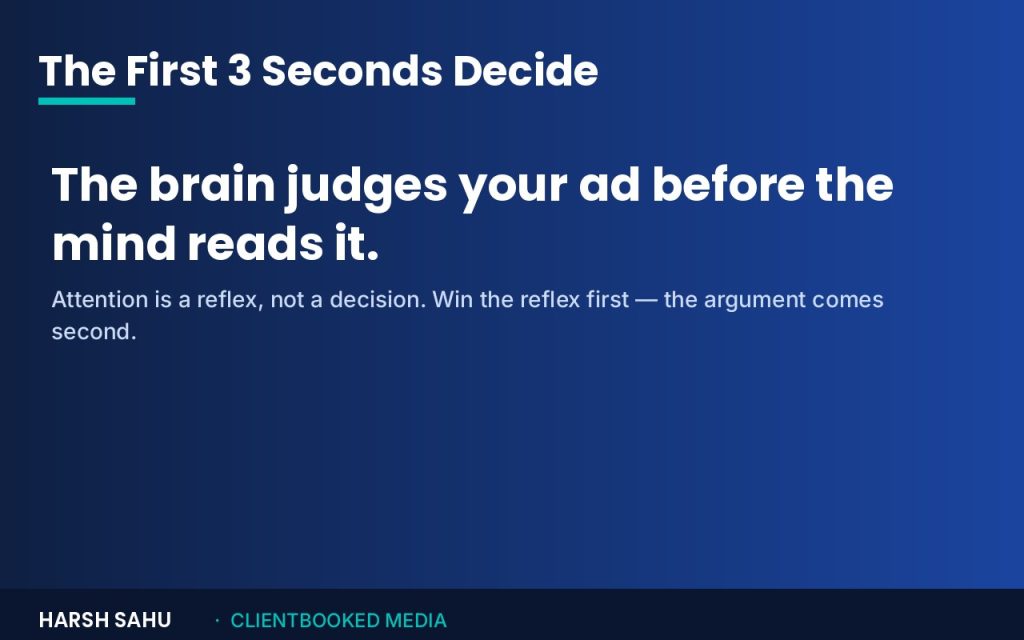
What actually stops a thumb
After years of building Meta ads for appointment-based businesses, I have learned that thumb-stopping is not about being louder. It is about being more relevant, faster. Four things do it reliably:
A face, looking at the camera. Humans are wired to notice faces before anything else. An ad that opens on a real person — not a stock photo, not a logo — borrows that wiring. The viewer reads the expression before she reads the words.
A sentence she already believes. The strongest opening line is not clever copy. It is a thought your customer has already had. “Tired of ads that bring clicks but no bookings?” works because the business owner reading it has said exactly that to herself. Recognition is instant. Cleverness takes time she won’t give you.
Movement with meaning. A slow zoom on a result, a hand writing on a whiteboard, a before-and-after that changes in front of her eyes — movement catches the filter’s eye. But movement without a point is just noise. The motion must carry the message, not decorate it.
One idea, not five. An opening frame that tries to say everything says nothing. One problem, one person, one promise. The rest of the ad exists to prove that first idea, not to add four more.
The test I run on every ad
Before any ad of ours goes live, it has to pass a simple test. I show the first three seconds to someone who knows nothing about the business and ask one question: “What is this about, and who is it for?”
If they can’t answer in one sentence, the ad fails — no matter how good the offer is, no matter how beautiful the creative. Because a viewer will never give it the time it takes to explain itself. The hook is not a garnish on the ad. The hook IS the ad’s first job, and everything else is the second job.
And here is the part people get wrong: they test the hook last. They build the offer, write the copy, design the landing page — and then, at the end, they ask what the first three seconds should be. That is backwards. Start with the hook. Build the ad around the moment of stopping. Then the rest has something to stand on.
What to do instead
If your ads are getting impressions but no clicks, or clicks but no bookings, don’t start by changing the budget or the audience. Start here:
- Watch your own ad as a stranger would. Mute it. Scroll past it. Does the first frame tell you, in one second, who it’s for and what problem it solves?
- Write three different opening lines — each one a sentence your customer has actually thought. Test them against each other before you test anything else.
- Cut anything from the opening that could belong to any business. If your first three seconds could be an ad for a dentist, a gym or a salon, they belong to nobody. Specificity is what stops the scroll.
The businesses that win on Meta are not the ones with the biggest budgets. They are the ones that understand the first three seconds are a psychology problem, not a design problem. Attention is earned in an instant and lost just as fast — and the advertisers who respect that are the ones whose ads actually get to do their job.
Want your ads to stop the scroll and start booking consultations? Book a free strategy call and we’ll look at your first three seconds together: https://calendly.com/clientbooked/30min — or reach me directly at https://harshsahu.in/contact/
Read more about my psychology-first approach to performance marketing here: https://harshsahu.in/why-human-psychology-beats-ad-tools-my-approach-to-performance-marketing/

Harsh Sahu
Performance marketer specialising in psychology-led Meta ads, offers and funnels for booked consultations. More about Harsh Sahu →