The Booking Funnel: 5 Steps Between a Click and a Consultation — Harsh Sahu
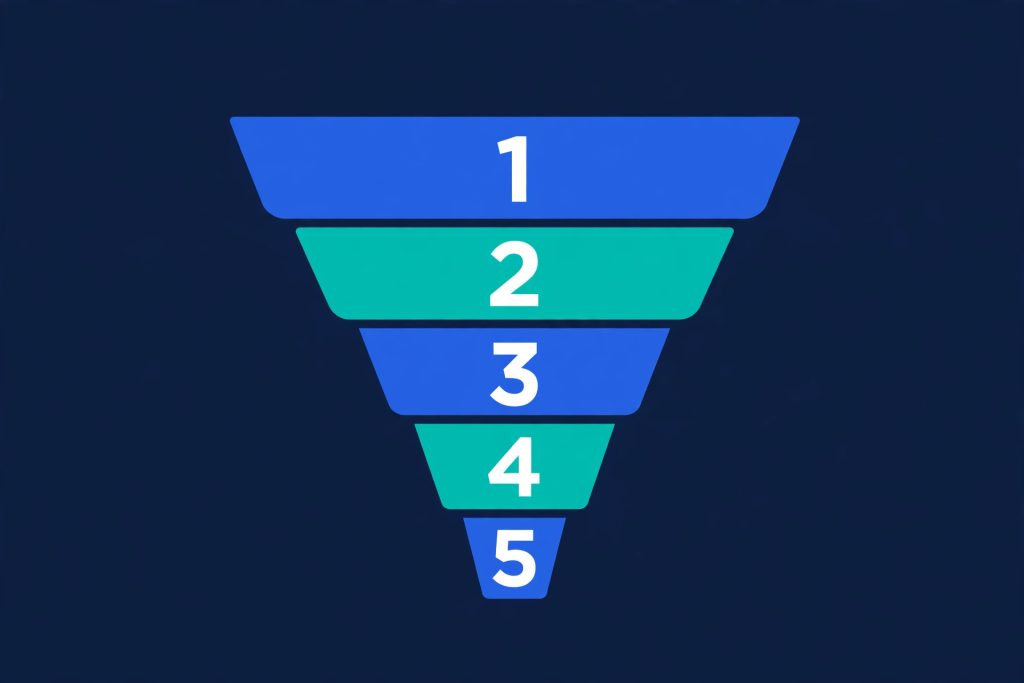
Most businesses think their funnel is one thing: the ad. The ad gets the click, the click becomes the booking, and if the bookings don’t come, the ad must be broken.
That is why so many businesses keep rewriting their ads while the real problem sits untouched, one step later, quietly eating their budget.
A click is not a booking. Between the two there are five steps, and a business loses people at every single one. The funnel is not a metaphor. It is a chain — and a chain breaks at its weakest link, not its strongest.
Here are the five steps, and what actually goes wrong at each one.
Step 1: The click — does the ad promise match what comes next?
The click happens in the first three seconds, and it happens because the ad made a promise the person wanted. “Book a free consultation.” “See if this treatment is right for you.” The person clicks expecting that exact thing.
The most common break at step one is not a bad ad. It is an ad that promises one thing and delivers another — the ad says “free consultation” and the page talks about the clinic’s history. The person’s brain does one fast calculation: “This isn’t what I clicked for.” And they leave.
The rule: the first line of whatever comes after the click must repeat the promise of the ad, in the same words. Same offer, same words, same feeling. A click is a small act of trust. Honour it immediately.
Step 2: The landing page — one message, one action
A landing page has one job: turn a click into a name and a number. Every extra link, every menu, every “learn more about us” is an exit door you built yourself.
I have seen landing pages that link to the homepage, the services page, the Instagram profile and a blog — four ways to leave before booking. The psychology is simple: confused people don’t act. They postpone. And postponed is the polite version of lost.
The decision rule: if a page element does not help the visitor book, it hurts the booking. One message, one action, zero distractions. A page that does one thing well will always beat a page that does five things politely.
Step 3: The form — every field is a tax
Every field on a booking form is a small price the visitor pays with their time and their privacy. Name and phone number: that is the price of a booking. Add date of birth, address, “how did you hear about us”, and a message box — and you have doubled the price for no reason.
The mechanism is friction. Each field is a tiny moment where the person can think, “Do I really want to do this right now?” And “right now” is the only moment you have.
Ask for the minimum: name, phone, and the service they want. Everything else can be collected after the booking, when the person is already committed. A short form is not lazy design. It is respect for the customer’s attention.
Step 4: The confirmation — commitment needs a receipt
Here is the step most businesses skip entirely. The person fills the form, sees a generic “thank you” page, and hears nothing until the appointment day. In their mind, nothing happened. No commitment was made, because nothing confirmed it.
Psychology calls this the commitment principle: people act in line with what they have already agreed to — but only when the agreement feels real. A confirmation message makes it real. A text that says “You’re booked for Tuesday at 4pm, here’s what to expect” turns a form submission into an appointment in the person’s mind.
The businesses with the fewest no-shows do one simple thing: they confirm immediately, by text, with the time, the place, and one line about what happens next. That message costs nothing. The no-show it prevents costs a full slot.
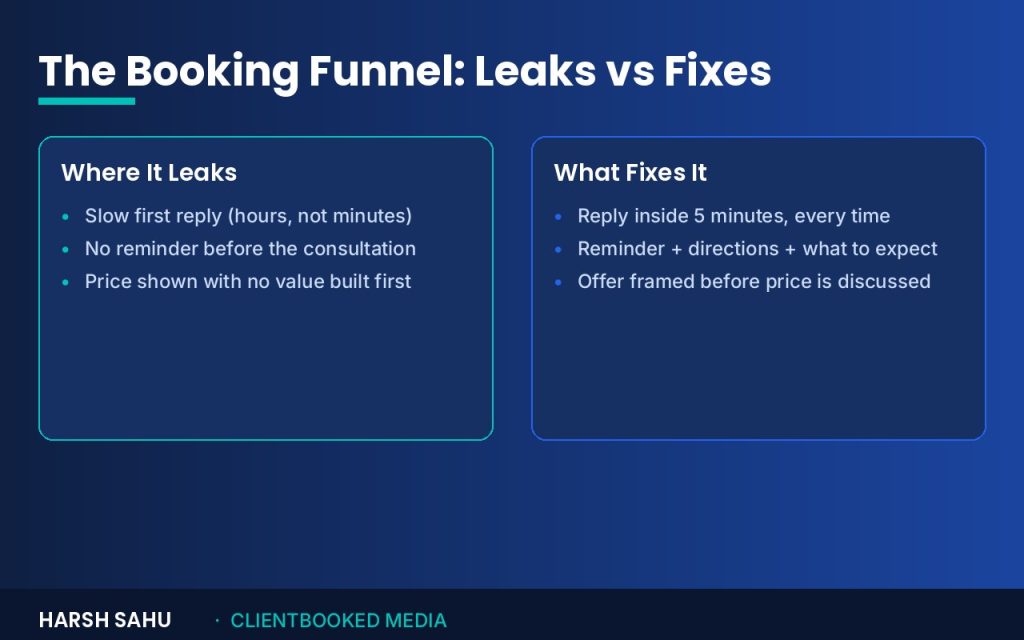
Step 5: The follow-up — speed is the whole game
The funnel does not end at the form. It ends at the conversation. And the conversation has a clock on it.
If your team replies tomorrow, your competitor replied in five minutes — and the customer booked with whoever made them feel looked after first. This is not a theory. It is the single most repeated pattern in appointment businesses: the first business to respond wins the booking, even when the second business is better.
At ClientBooked Media, this is the system we build around every ad campaign: the ad makes a clear promise, the page keeps it, the form stays short, the confirmation makes it real, and the follow-up happens in minutes, not days. The ad is step one of five. Anyone selling you step one and calling it a funnel is selling you a third of a system.
The check you can run today
Open your own funnel as a customer. Click your ad. Read the page. Fill the form. Wait for the confirmation. Time the reply.
Wherever you felt friction, confusion or silence — that is where your bookings are dying. Fix the weakest step first. A funnel is a chain, and one repaired link lifts everything after it.
Harsh Sahu is the founder of ClientBooked Media, where he builds psychology-led Facebook and Instagram ad campaigns for appointment-based businesses. Read more about how he works at https://harshsahu.in/what-i-do/ — or book a call at https://harshsahu.in/contact/.

Harsh Sahu
Performance marketer specialising in psychology-led Meta ads, offers and funnels for booked consultations. More about Harsh Sahu →